
Utah County Court Records After Arrest
Utah County has a clear split between the jail side and the court side. The Utah County Arrested Person Search is a sheriff roster. It can show the arrest date, booking date, booking number, arresting agency, status, charge cards, court name, case number, charge description, and bail. That is useful right after an arrest because the jail profile may be the first public record that ties a person to a court or case number.
The formal Utah County court record is different. Utah Courts Xchange is the statewide public case-search route for district court and justice court case information. Court records after a jail arrest can include filed counts, parties, assigned judge, attorneys, filed documents, hearings, judgments, and outcomes of completed cases. For booking status, roster data, and custody details, use jail inmate records. For booking photos, use jail roster mugshots. Court records are the place to verify what charges were filed and how each case moved after the arrest.
Find Utah County Arrest Court Records
Utah Courts describes Xchange as the repository for district court and justice court case information. Public case information appears after court staff enter it into CORIS, the local court computer system. A felony or class A misdemeanor arrest in Utah County will usually move through district court. Most class B and class C misdemeanors, infractions, traffic cases, and small claims are handled by justice courts. That court split matters because the jail charge card may point to Fourth District Court, Utah County Justice Court, or a municipal justice court.
The most reliable first step is to copy the court and case number from each Utah County jail charge card. Use the case number first when it is present. If the jail charge card does not show a case number yet, search by name and use Utah Courts wildcard tips. Xchange is a court-record system, not a jail roster. It will not show housing, commissary, visitation eligibility, or booking photos.
- Open the Utah County jail profile and copy the court, case number, charge description, and bail label from each charge card.
- Open Utah Courts Xchange and search by case number when one appears on the roster.
- If no case number is listed, search by defendant name, using a last name plus wildcard and first-name letters when needed.
- Compare the roster charge text with the court count, docket entries, hearing list, disposition, and status.
- Use a courthouse public terminal or contact the court of jurisdiction if online Xchange access is not enough.
The Utah Courts public-record access page notes that free public Xchange access is available at many district courthouses and at the Utah State Law Library. Paid Xchange access has a setup fee, a monthly subscription, search limits, extra-search charges, and document-image fees where public district court document images are available.
The official Xchange page is the source for Utah public case-search access after a Utah County arrest.
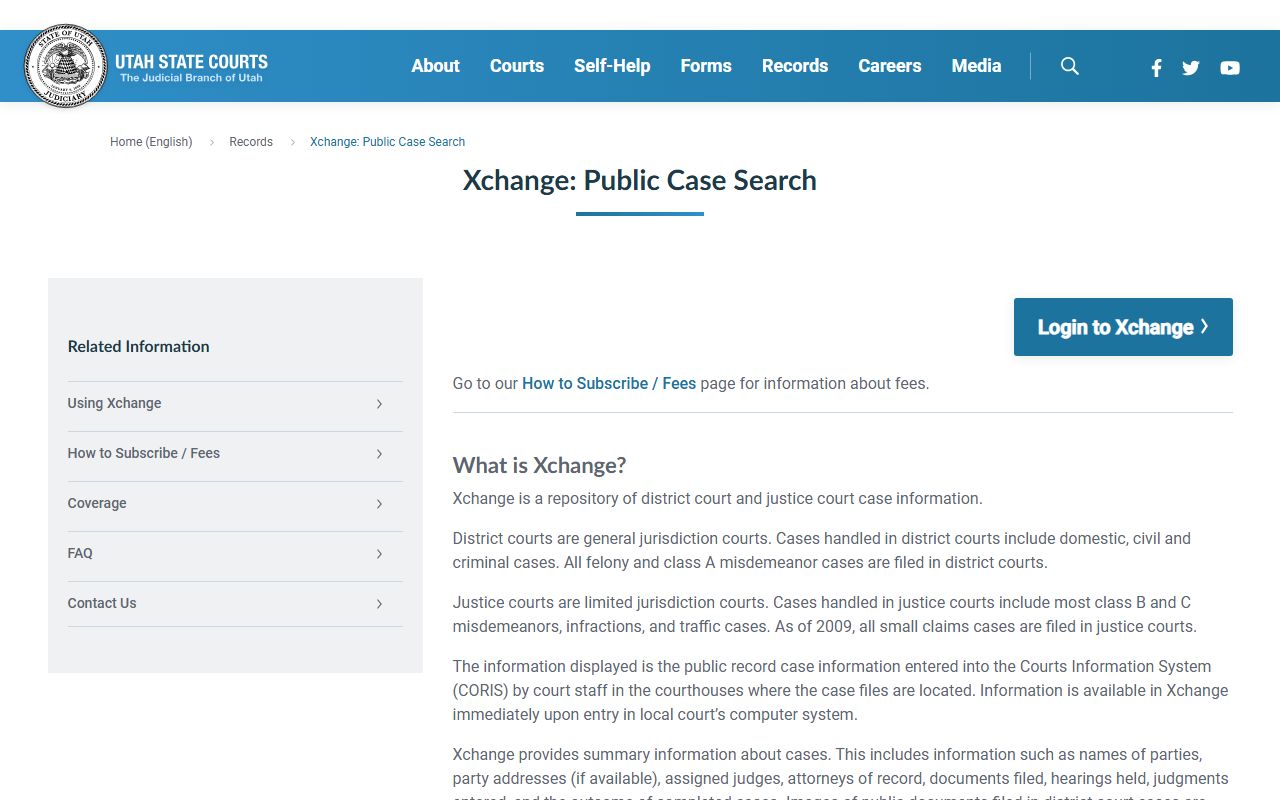
Xchange should be used for filed court charges and case outcomes, while the sheriff roster remains the source for booking and custody status.
Utah County Court Search Fields
Utah Courts provides both a login portal and guidance for public case searches. Subscriber access requires a username, password, and CAPTCHA entry. The court help material also describes name-search patterns, including wildcard searches, which can help when the jail roster has a name but no case number. For a party to a case, MyCase may allow account access when the user has an email address, case number, and government ID.
| Field | Use | Notes |
|---|---|---|
| Username | Xchange login access | Required for subscriber access to the login portal. |
| Password | Xchange login access | Used with the account and CAPTCHA. |
| CAPTCHA characters | Login verification | The portal displays characters that must be typed before access. |
| Case number | Direct case lookup | Best search when the Utah County jail charge card lists a case number. |
| Name | Defendant search | Utah Courts help suggests wildcard searches for broader name matching. |
Utah County Arrest Charges Filed
A Utah County arrest can begin as a booking charge, a warrant hold, a commitment, or another agency hold. The court record begins when a charging document is filed in the proper court. The Utah County Attorney's Criminal Division prosecutes felony and class A misdemeanor cases, while city attorneys may handle infractions and class B or class C misdemeanors in municipal contexts. That means the same jail roster can point to county-level prosecution in one case and city-level prosecution in another.
| Complaint | Information | Indictment | |
|---|---|---|---|
| Filed by | Officer or prosecutor, depending on the case path | Prosecutor | Grand jury |
| Common use | Early case filing and many misdemeanors | Many felony filings after screening | Serious felony matters when a grand jury is used |
| What it starts | A public court case when entered | A formal court case and filed counts | A court case based on grand-jury action |
| Reader focus | Compare to booking charge text | Check each count and degree | Read court docket entries and filed documents |
The public court record should be treated as the formal source for filed counts and disposition. A roster charge may be a warrant basis, a new-charge hold, or a charge card that later changes after prosecutor screening.
Utah County Charge Status
Charge status can change after a Utah County jail arrest. Prosecutors may amend a charge, reduce it, add a count, dismiss a count, or proceed on a different filing theory than the first jail description suggests. The public roster also uses charge cards that can show "Arrested/Held For: Warrant of Arrest," "Arrested/Held For: New Charge," or "Not Holding On This Charge." A single booking may have several charge cards, and each card can have a different case number, bail amount, and bailability label.
| Status | What It Means |
|---|---|
| Pending | The charge has been filed or remains active but has not reached a final disposition. |
| Amended | The prosecutor changed the charge text, count, degree, or other filed detail. |
| Reduced | The charge was lowered to a lesser offense or lower degree. |
| Dismissed | The charge ended without a conviction on that count. |
| Warrant case | The booking may be tied to an older court case or warrant rather than a new case. |
The court docket is also the better place to check hearings and outcomes. Utah County's booking-process page says Booking does not give out court dates and directs callers to the court of jurisdiction.
Utah County Bond After Arrest
Bond and bail information often appears first in the Utah County jail profile. The roster detail script shows bail at the charge level, not just as one total. Each public charge card can include a court, case number, charge description, bail amount, Bond or Not Bailable label, and release type. If bail is greater than zero and the release type is blank, the page can render a Pay Bail button. If a matching payment exists, the detail can show "Payment pending."
Utah County's booking-process information gives practical payment limits. Credit cards may be used for bail in person, but an additional transaction charge applies. The jail cannot take credit-card payments by phone. The payer must bring the exact amount, loose change and personal checks are not accepted, and cashier's checks or money orders must be payable to "The Utah County Jail." Booking can be reached at 801-851-4210 to confirm custody and release issues before payment.
| Release Route | Utah County Detail |
|---|---|
| Cash bail or fine | Accepted route when eligible; exact amount is required. |
| Bail bond company | Family may contact a bondsman, but the jail will not refer callers to one. |
| Release order | The court can order release, but Records must receive and process paperwork. |
| ROR or own recognizance | Roster release code ROJ means release OR by judge. |
| Hold or transfer | Immigration, state prison, hospital, AP&P, or another agency hold may prevent release. |
Utah County Warrants And Arrest
A warrant can create the arrest that later leads to court records. The Utah County Sheriff's warrants page directs users to the Utah State Warrants Search for active warrant checks. The sheriff also lists warrant contact options at 801-851-4065, 801-851-4034, and warrants@utahcounty.gov. A person who believes they have an outstanding warrant and wants to pay bail or fines can use the sheriff's pay-warrants page or contact an Investigative Specialist.
The warrant path can affect how the court record reads. A roster charge card may say "Warrant of Arrest" or may use a warrant code. That does not always mean a new criminal case was filed from the latest arrest. It may mean the person was booked on a prior case, a failure-to-appear warrant, or another court order. If a warrant is recalled, Utah County Booking says the paperwork normally must state release by judge or ROR, not merely "warrant recalled."
The sheriff's warrants page is the local access point for Utah County warrant contact details and statewide warrant-search routing.
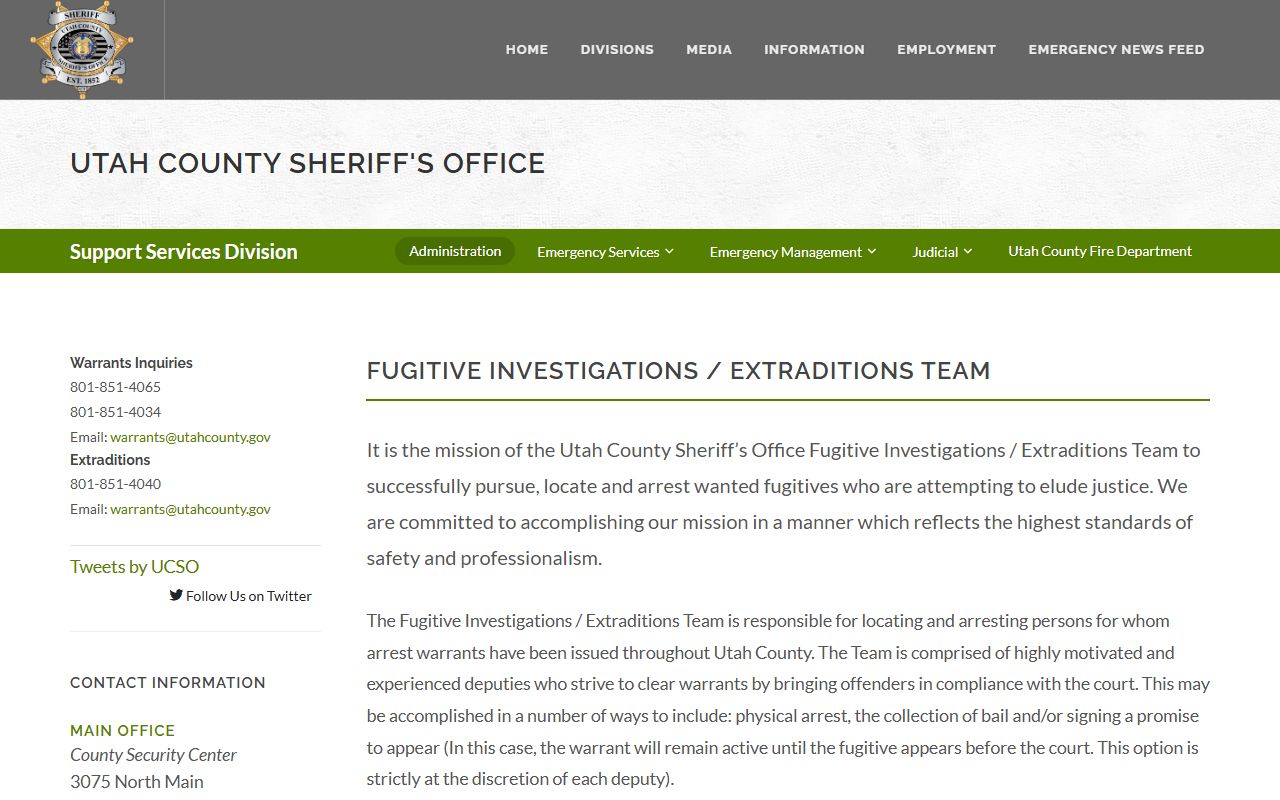
Warrant records should be checked with the sheriff warrant office and the court of jurisdiction before anyone treats online results as a release decision.
Utah County Prosecutor Role
Utah County has a County Attorney rather than a district attorney label. The current County Attorney is Jeffrey S. Gray, and the Utah County Attorney Criminal Division prosecutes criminal cases in Utah County Justice Court, district and appellate courts, and criminal or delinquency matters in juvenile courts. The division also acts as a liaison and gives criminal-matter advice to Utah County law-enforcement agencies. The current Criminal Division chief listed in the research is Chad Grunander.
This matters when comparing arrest charges to court records. The jail may show a charge before the prosecutor has finished screening the case. Felony and class A misdemeanor charges commonly involve the Utah County Attorney's Office. City attorneys may prosecute many class B and class C misdemeanor cases. A Utah County court record after arrest should therefore be read by court, case number, charge level, and filing status, not by jail charge text alone.
The Utah County Attorney Criminal Division page confirms the office's criminal prosecution role in Utah County courts.
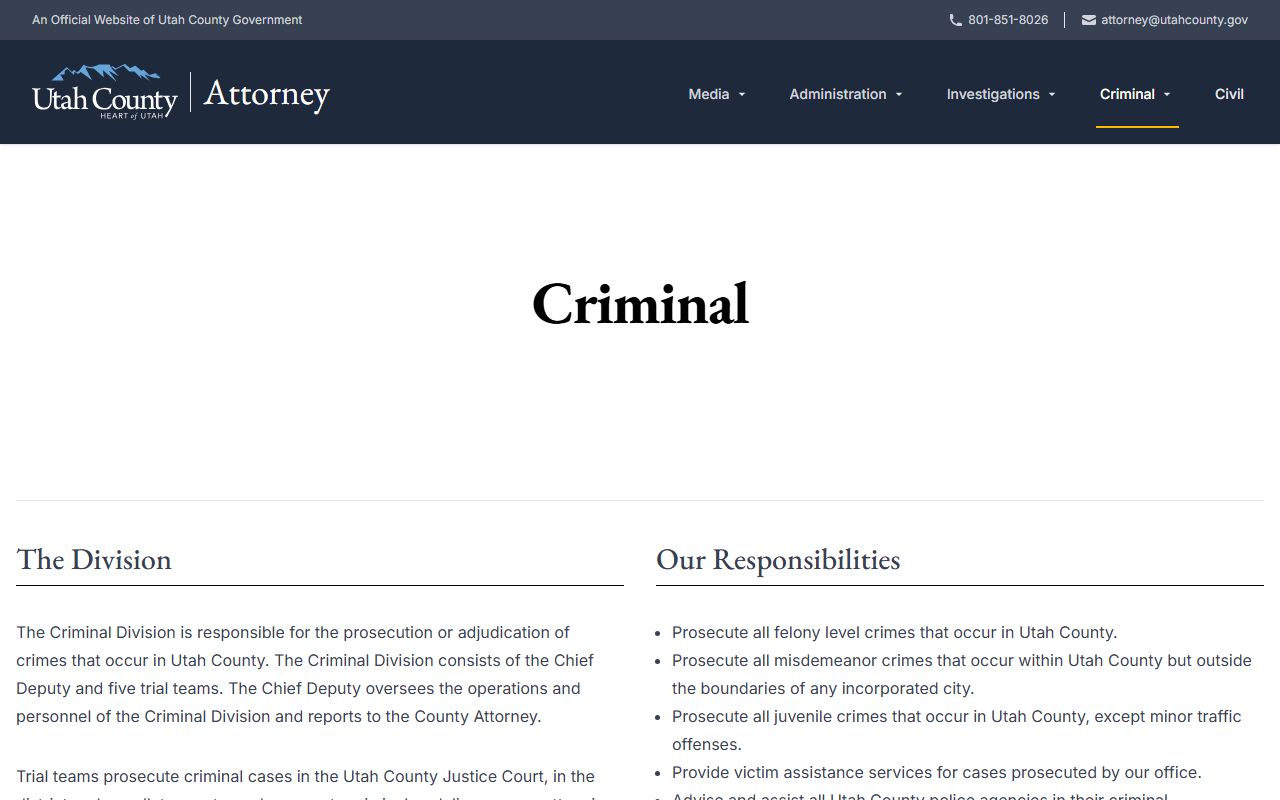
The prosecutor page helps explain why a booking charge may later appear in Xchange with a different count, degree, or disposition.
Charges Versus Convictions
An arrest and a charge are not the same as a conviction. The jail roster may show why a person was booked or held. The court record shows the filed case, court events, and final outcome if the case is completed. A person can be arrested and released, charged and later dismissed, convicted by plea or verdict, or held on a warrant from an older case.
| Charge | Conviction | |
|---|---|---|
| Stage | Accusation or filed count after arrest screening | Guilty plea, verdict, or other adjudicated outcome |
| Proof level | Based on probable cause and prosecutorial filing choices | Requires proof beyond a reasonable doubt or a valid plea |
| Where to check | Jail charge card plus Xchange filed counts | Xchange disposition, judgment, and court minutes |
| Risk | Can be amended, reduced, or dismissed | May carry sentence, fines, probation, or custody consequences |
Utah County Sealed Arrest Records
Utah public access is governed by GRAMA and court-record rules. Utah Code 63G-2-201 gives the general right to inspect public records, subject to classifications and restrictions. Utah Code Title 77 Chapter 40a is the expungement chapter used for record-clearing issues. Xchange does not display sealed cases, expunged cases, adoptions, civil commitments, juvenile delinquency, child welfare, or termination of parental rights cases.
| Sealed | Expunged | |
|---|---|---|
| Public view | Hidden from ordinary public inspection when sealed by law or court order. | Removed from ordinary public access under Utah expungement rules when eligible. |
| Xchange display | Utah Courts says sealed cases are not shown. | Utah Courts says expunged cases are not shown. |
| Route | Court order, statute, or court-record restriction. | Eligibility and process under Utah Code Title 77 Chapter 40a. |
| Important limit | Some agencies may retain limited lawful access. | Do not assume all past copies vanish from every system without an order. |
Utah County Background Checks
Casual court-record lookup is not the same as an FCRA-compliant background check. Court records after a jail arrest may be incomplete, sealed, expunged, delayed, amended, or tied to a person with a similar name. Employers, landlords, insurers, lenders, and screening firms have separate legal duties when they use criminal-history information for decisions covered by the Fair Credit Reporting Act.
Important: Utah County Inmate Population is not a consumer reporting agency and cannot be used for FCRA-covered screening.
Restricted Utah County Court Records
Some records are not open through Xchange or the sheriff roster. Utah Courts excludes sealed and expunged cases, juvenile delinquency, child welfare, termination of parental rights, adoptions, and civil commitments from public Xchange display. The Utah County Sheriff's Records Office also classifies records as public, private, protected, or controlled under GRAMA. A records request must go to the government entity that keeps the record, and the sheriff's local process requires photo ID before release and a notarized release when requesting for another person.
For sheriff records not found online, use the Utah County NextRequest portal or the Sheriff's Records Office. The local records page says reports start at $15, body or dash camera records have separate charges, and the office asks requesters to allow 10 business days except in extraordinary circumstances. Records Office hours are Monday through Thursday, 8:00 a.m. to 5:00 p.m., and Friday, 8:00 a.m. to noon. The records phone is 801-851-4500, and the email is SheriffRecords@utahcounty.gov.